Budget vs. Premium GPS Bike Computers: Is a $500 Unit Worth It for Rail Trail Riding?
As an Amazon Associate I earn from qualifying purchases. If you buy through a link on this page, Rail Trail Life may earn a small commission at no extra cost to you.
Prices were checked on October 26, 2026 and change often, sometimes daily. Click through to see today’s price.
If you’ve been riding rail trails with your phone strapped to the bars (or stuffed in a jersey pocket), you’ve probably wondered whether a real bike computer is worth it. A good GPS unit shows you the trail map at a glance and tells you where the next trailhead is. It also records your miles without killing your phone battery before lunch.
The tricky part is price. Bike computers run from about $150 to $500 and up, and the spec sheets all look alike. So we compared four popular models across that range, looking at what matters most on a rail trail: easy-to-read maps, battery that lasts a long day, a screen you can read in bright sun, and controls that aren’t a headache.
This is a researched comparison, built from manufacturer specs and independent reviews from DC Rainmaker, BikeRadar, Cyclingnews and road.cc. It’s not a lab test. Where reviewers’ real-world numbers differ from the brand’s claims, we say so.
Quick Picks
| If you want… | Pick | Approx. price* |
|---|---|---|
| Best value / biggest screen for the money | iGPSPORT BSC500 | ~$150 |
| Best all-rounder under $200 (longest claimed battery) | Bryton Rider 650 | ~$200 |
| Biggest, easiest-to-read map screen | Wahoo ELEMNT ACE | ~$480–$500 |
| Most features and safety tools (button-only) | Garmin Edge 550 | ~$490–$500 |
*Approximate US prices seen on Oct 26, 2026. Check the link for the current price.
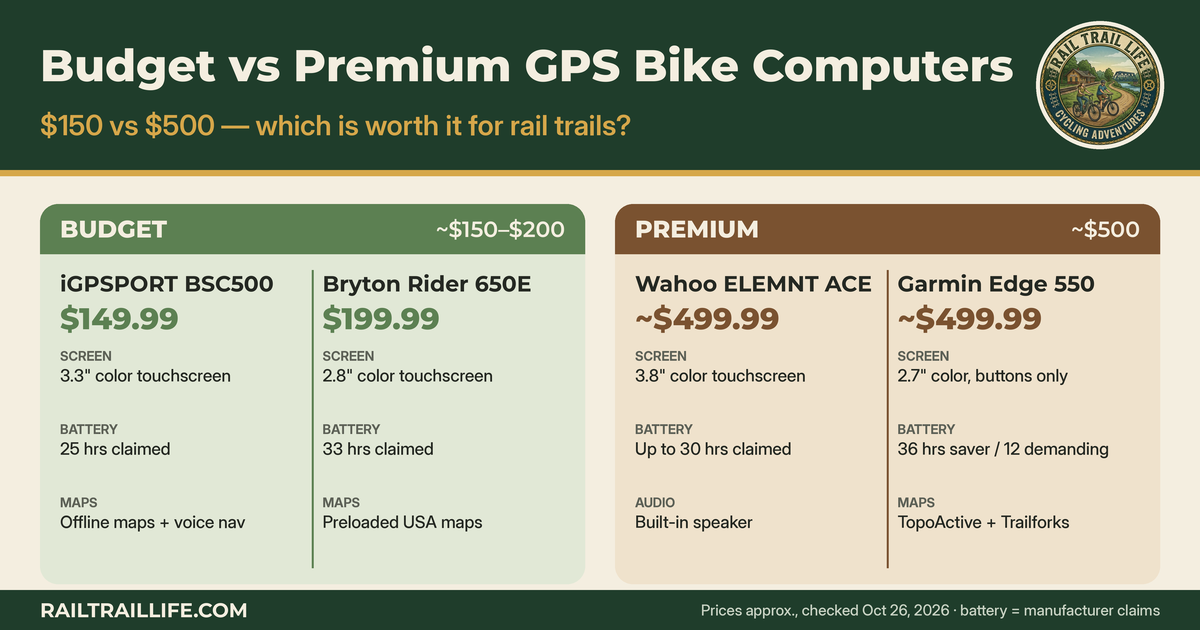
Our short answer: For most rail trail riders (casual to long-distance, mostly flat, mostly paved), a $150–$200 computer covers almost everything you need. The $500 units add polish, better software, safety features and a stronger app ecosystem. They don’t make a flat 30-mile trail ride feel any different.
Side-by-Side Specs
| iGPSPORT BSC500 | Bryton Rider 650 | Wahoo ELEMNT ACE | Garmin Edge 550 | |
|---|---|---|---|---|
| Approx. price (Oct 2026) | $149.99 (bundle w/ sensors $207.99) | $199.99 (650E device only) | ~$480–$500 on Amazon; $499.99 at Wahoo | ~$490–$497 on Amazon; $499.99 list |
| Screen | 3.3″ color touchscreen, 320×480 | 2.8″ color touchscreen | 3.8″ color touchscreen (480×800 per Amazon listing) | 2.7″ color, 420×600, no touchscreen |
| Controls | Touch + 3 buttons | Touch + 5 buttons | Touch + buttons | Buttons only |
| Claimed battery | 25 hrs | 33 hrs | Up to 30 hrs | 12 hrs “demanding use” / 36 hrs battery saver |
| Battery reviewers saw | ~11–13 hrs (heavy nav + 3 sensors, one review) | ~14.5 hrs (BikeRadar, with sensors + radar) | ~10–17 hrs (DC Rainmaker); ~15 hrs (road.cc); ~25 hrs (Gran Fondo, one controlled test) | ~10–12 hrs (DC Rainmaker, auto brightness); ~20 hrs at 30% brightness |
| Maps | Offline maps, voice navigation | Preloaded USA (OSM) maps, turn-by-turn | Maps, turn-by-turn, built-in speaker | Preloaded TopoActive + Trailforks maps, turn-by-turn |
| Spoken / audio prompts | Yes (voice navigation) | Audio alerts before turns (spoken voice not confirmed) | Yes, built-in speaker | No speaker for voice prompts |
| GPS | Dual-band (L1+L5), full GNSS | GPS, GLONASS, Galileo, BeiDou, QZSS | Dual-band, multi-GNSS | Multi-band GNSS |
| Weight | 107 g | 92 g | 208 g | ~110–112 g |
| Water rating | IPX7 | Up to 1 m for 30 min | IPX7 | IPX7 |
| Connectivity | ANT+, Bluetooth | ANT+, Bluetooth | ANT+, Bluetooth 5.0, Wi-Fi | ANT+, Bluetooth, Wi-Fi |
| Radar support | Yes | Yes | Yes | Yes (Garmin Varia) |
| Charging | USB-C | USB-C | USB-C | USB-C |
| Amazon ASIN | B0GVNJJT6F | B0FCSM2F61 | B0DK9SYKP2 | B0FQCLW575 |
Specs come from manufacturer spec pages and Amazon listings. Battery “reviewers saw” figures come from the independent reviews named above, and your results will vary with brightness, sensors and navigation use.
What Matters on a Rail Trail (and What Doesn’t)
Before the individual reviews, here’s a quick reality check from the rail trail point of view:
- Navigation and maps matter most. Rail trails cross roads, pass old depots, and split at trailheads. A map that shows the trail and nearby streets saves you a lot of “wait, is this the turn?” moments.
- Battery matters if you ride long. A 40–60 mile out-and-back on a long trail can easily take 4–6 hours with stops. Every unit here handles that. The question is whether you’ll charge it after every ride or once a week.
- Sun-readable screens matter in the South. On an open Florida trail at noon, a dim screen is a real problem. Reviewers flagged the BSC500 (transmissive screen) and the Rider 650 (auto-brightness a bit dim) as places to watch.
- Climbing tools barely matter. Rail trails are famously flat (old railroad grades rarely top 2–3%), so features like ClimbPro or Climb Challenge are nice extras, not deal-makers.
- Safety features are a real plus. Live tracking for family, crash/incident detection, and rear radar support are worth having on long solo rides.
iGPSPORT BSC500: The Big-Screen Budget Pick (~$150)
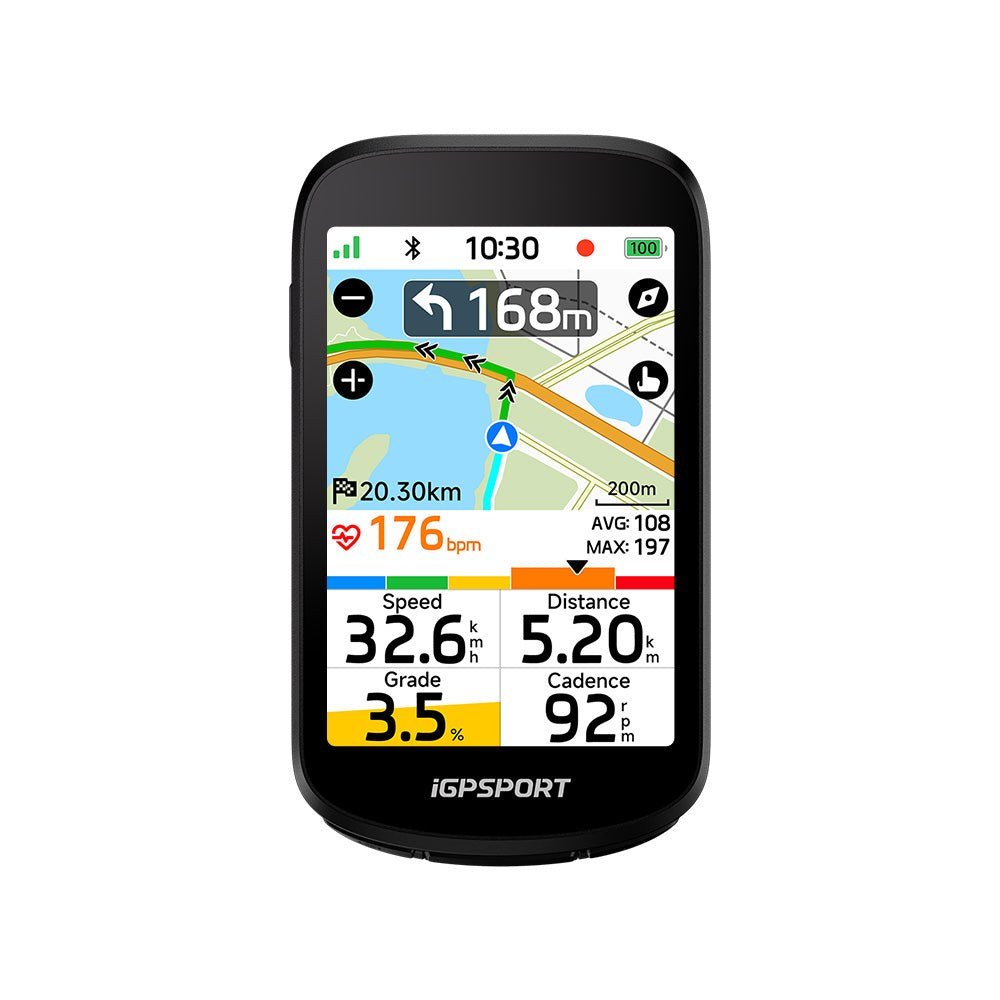
The BSC500 is the one that makes you double-check the price tag. For about $150 you get a 3.3-inch color touchscreen, which is bigger than the Garmin and Bryton screens, along with offline maps, voice navigation, dual-band GPS and a claimed 25 hours of battery. Amazon also lists a bundle with sensors for $207.99.
What reviewers liked: the large, sharp map screen, accurate GPS, simple auto start/stop, and easy Komoot and Strava syncing. Several owners mentioned that the spoken turn prompts and the way the map zooms in at turns are genuinely helpful.
What to watch: it uses a transmissive screen, which looks great but relies on its backlight, so in strong summer sun you may need to turn the brightness up. That costs battery. One Spanish reviewer measured roughly 11–13 hours of real use with navigation and three sensors running, well below the 25-hour claim. Owners also report some software quirks (data page setup, laggy map zooming), which isn’t unusual at this price.
Pros
- Biggest screen for the money
- Voice navigation and offline maps
- Dual-band GPS, IPX7, USB-C
- Very affordable; sensor bundle available
Cons
- Screen can be harder to read in bright sun
- Real-world battery well under the 25-hour claim when navigating
- Software is less polished than Garmin’s or Wahoo’s
Best for: riders who want a big, easy map screen and turn-by-turn directions without spending much. It’s a great first bike computer for someone moving up from a phone.
Bryton Rider 650: The Best-Value All-Rounder (~$200)
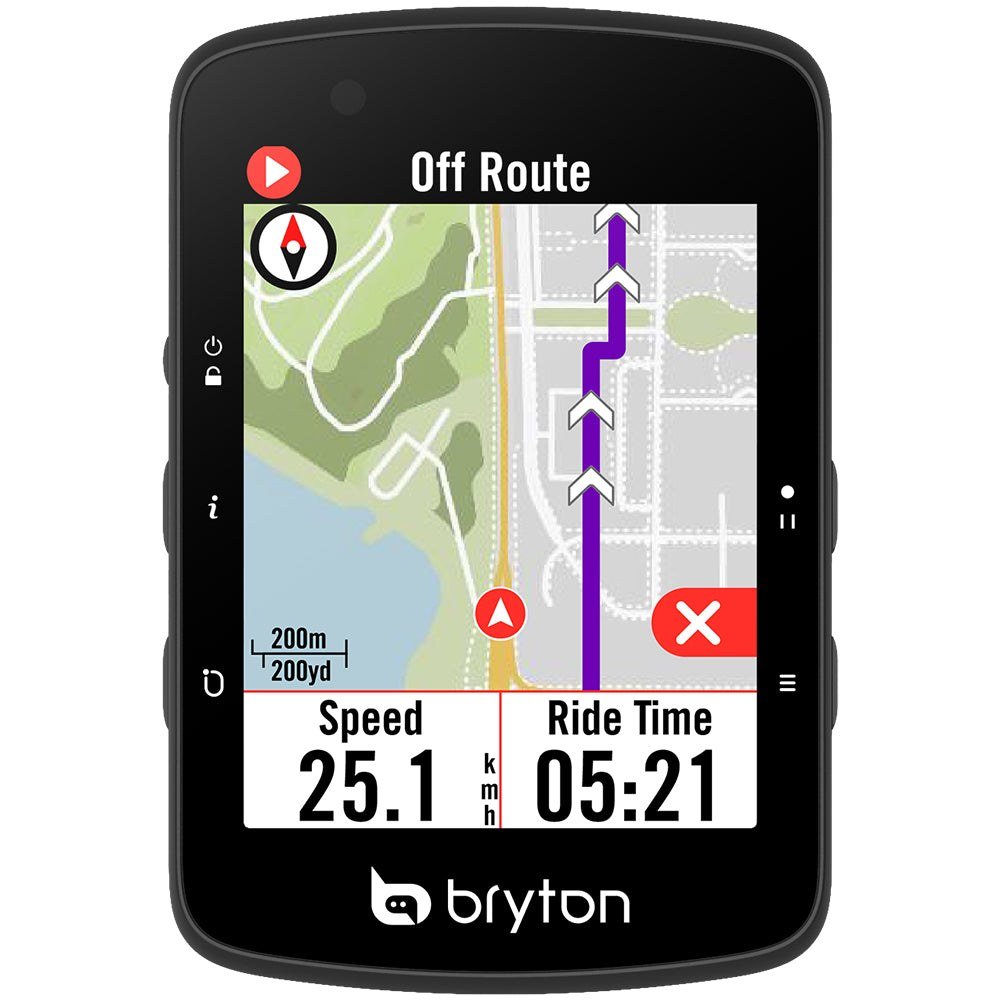
BikeRadar called the Rider 650 “the best-value performance GPS” they’ve tested and gave it 4.5/5. It packs a 2.8-inch color touchscreen with five physical buttons as backup (handy with gloves or rain), preloaded USA maps, turn-by-turn directions, and the longest claimed battery in this group at 33 hours.
It also supports radar tail lights, live tracking (so family can follow along), smart notifications, e-bikes and electronic shifting, and it syncs with Strava, Komoot, Ride with GPS and TrainingPeaks.
Real-world battery: BikeRadar got about 14.5 hours with a power meter, electronic shifting and a radar light connected. That’s well short of 33, but still plenty for a long trail day, and with fewer sensors (typical for trail riding) you’d likely see more. (The higher number is our estimate, not a measured result.)
What to watch: reviewers say the auto-brightness can run a little dim and the map colors are a bit busy. Rerouting and “back to start” reportedly need the phone app and a data connection. The Amazon listing is rated 3.8 stars, lower than the professional reviews, so read recent buyer reviews before you order.
Note on versions: the 650E is the device only; the 650T bundle adds sensors. BikeRadar’s launch price was $169.95, and it’s currently $199.99 at both Amazon and Bryton USA.
Pros
- Longest claimed battery (33 hrs)
- Touchscreen and buttons
- Preloaded USA maps, live tracking, radar support
- Light (92 g) and compact
Cons
- Auto-brightness can be dim; busy map colors
- Some navigation features rely on the phone app
- Mixed Amazon ratings compared with reviewer scores
Best for: long-distance trail riders who want maps, safety features and long battery life at a fair price. If we had to pick one unit for most rail trail riders, this would be it.
Wahoo ELEMNT ACE: The Big-Screen Premium Navigator (~$480–$500)
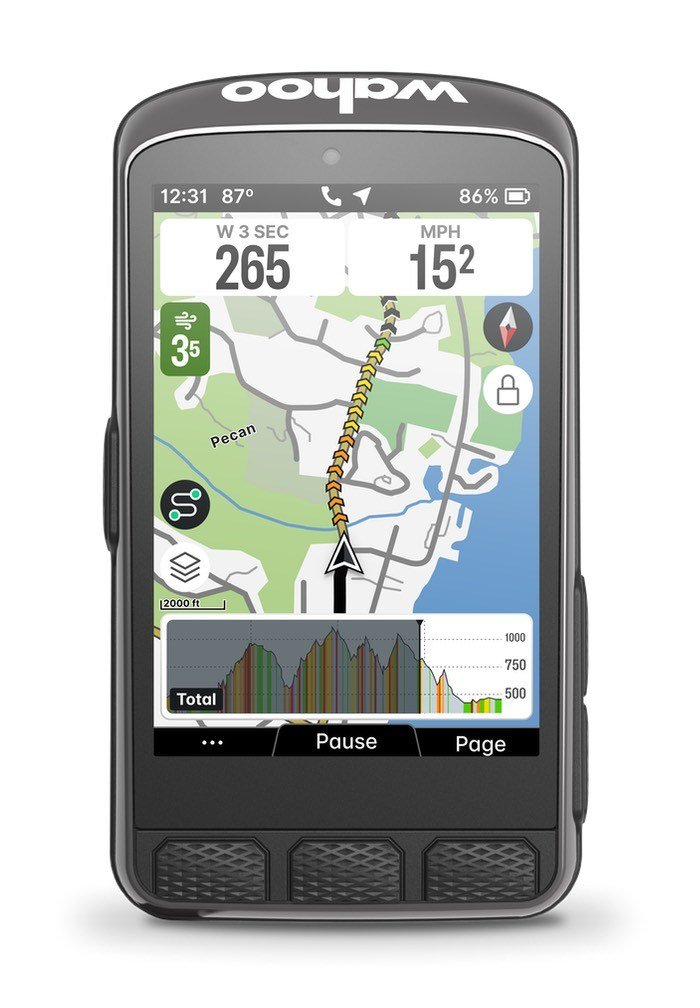
The ACE is Wahoo’s flagship and its largest computer ever: a 3.8-inch color touchscreen that works with pinch and swipe like your phone. It adds a built-in speaker for spoken turn prompts, dual-band GPS, 64 GB of storage, Wi-Fi, and even a built-in wind sensor. Wahoo lists it at $499.99. On Amazon it was showing about $480–$496 from other sellers on the day we checked.
What reviewers liked: navigation. Cyclingnews called it “truly superb,” and the big map with the in-map elevation profile is easy to follow. Wahoo’s phone app makes setup simple.
What to watch:
- Size and weight. At 208 g, it’s nearly twice the weight of the others, and Wahoo notes you may need a separate mount depending on your handlebars.
- Battery vs. claims. Wahoo claims up to 30 hours, but that assumes the backlight shuts off after 5 seconds. DC Rainmaker measured about 10–15 hours in default auto-backlight mode, and road.cc got about 15. Gran Fondo got about 25 hours in one controlled test, so results vary a lot by setting and software version.
- Startup. Cyclingnews found it slow to lock onto GPS.
- The wind sensor is fun but not something a trail rider needs.
Pros
- Largest, most phone-like screen here
- Excellent navigation with spoken prompts
- Polished app and setup
- Lots of storage, Wi-Fi updates
Cons
- Big and heavy; may need a different mount
- Real battery life often well below the 30-hour claim
- Expensive for what casual riders will use
Best for: riders who mainly want the biggest, easiest map to follow and don’t mind the bulk, such as touring riders or anyone whose eyes appreciate a larger screen.
Garmin Edge 550: The Feature-Packed Premium Pick (~$490–$500)
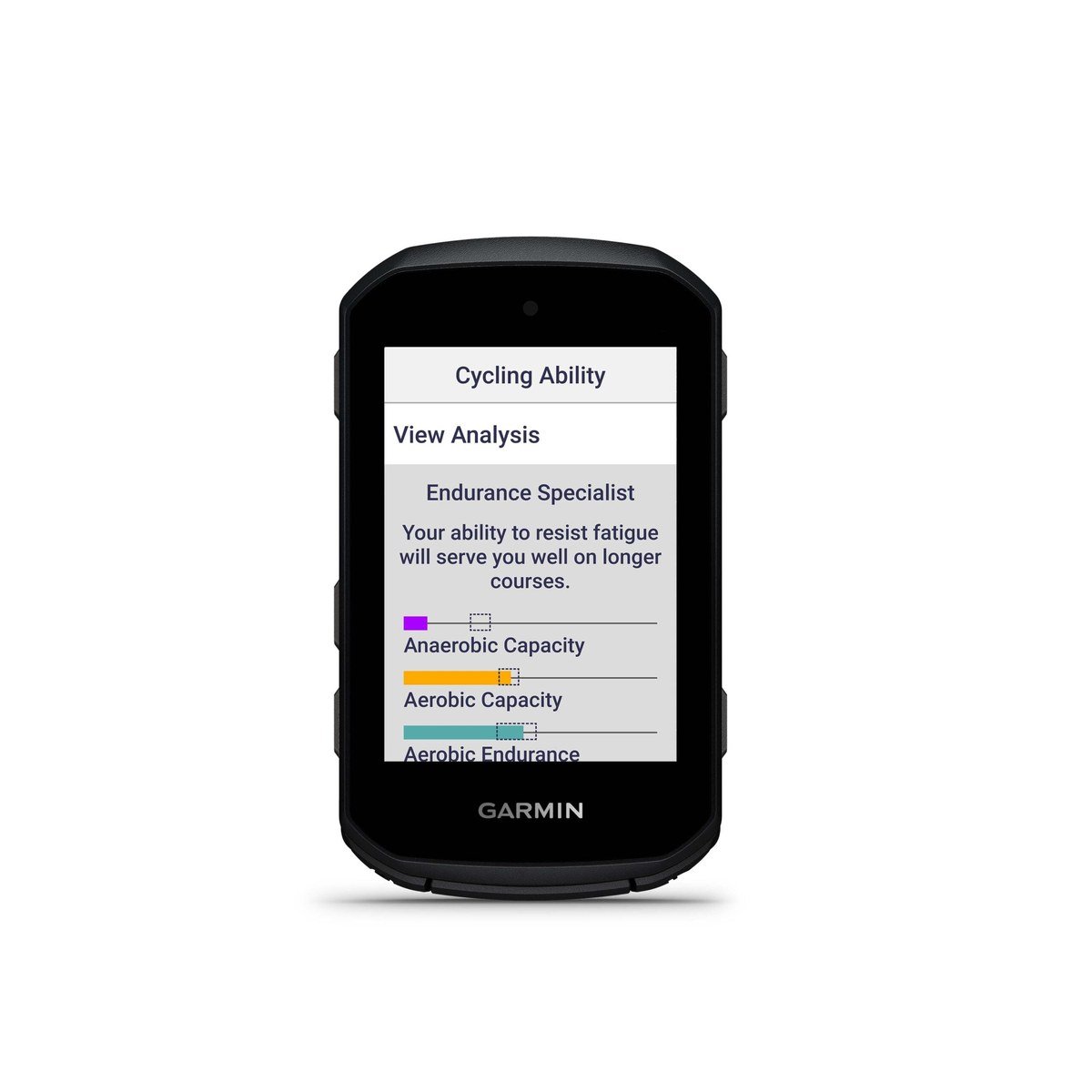
Garmin is the name most cyclists know, and the Edge 550 is its newest mid-size unit. It has a sharp 2.7-inch color display (420×600), multi-band GPS, preloaded TopoActive maps plus Trailforks trail data, on-device address search and rerouting, and Garmin’s full set of training and safety features. Those include LiveTrack for family, incident detection, road hazard alerts, weather radar overlays, and Varia radar support. List price is $499.99. On Amazon it was about $490–$497 when we checked.
The big catch: no touchscreen. The Edge 550 is buttons-only (the pricier Edge 850 adds touch and a speaker). Some riders prefer buttons with sweaty or gloved hands. Others, including Cyclingnews and BikeRadar, found the menus fiddly to get around without touch.
Battery is the other trade-off. The brighter screen drinks power. Garmin claims 12 hours in demanding use and 36 hours in battery saver, and DC Rainmaker measured right around 10–12 hours on auto brightness. Turning brightness down to 30% roughly doubled that to about 20 hours, though the screen was harder to read in direct summer sun. For a 3–5 hour trail ride that’s fine, but you’ll charge it more often than the others.
Pros
- Best overall feature set and safety tools
- Sharp, bright screen
- Strong maps, on-device rerouting, Garmin Connect ecosystem
- Works with Garmin Varia radar and lights
Cons
- No touchscreen; menus can be fiddly
- Shortest real-world battery in this group at default brightness
- Most expensive per feature that a casual trail rider will actually use
Best for: riders already in the Garmin world (watch, Varia radar) or anyone who wants the most complete safety and training features and is fine charging often.
Honorable Mention: Bryton Rider S810
If you like the Bryton approach but want a bigger screen, the Rider S810 steps up to a 3.5-inch color touchscreen, offline maps, live tracking, Strava Live Segments, and a claimed 50-hour battery. BikeRadar notes it adds predictive climb features the 650 lacks. Prices were all over the place when we checked: about $246 at Bryton USA, and $332–$350 on Amazon depending on the listing. Shop around before you buy. (We didn’t dig into independent battery tests for this one.)
A Note From Michael
I’m Michael, and I’ve been riding rail trails for a couple of years, mostly around Northeast Florida, like the Jacksonville-Baldwin Rail Trail. Rail trails are flat, well marked and usually out-and-back, so you don’t need a $500 navigation powerhouse to enjoy them. What matters most is a screen you can read in the sun, a battery that lasts for a few long rides between charges, and accurate mileage so you know when to turn around. Keep those three things in mind as you compare the options above.
Which One Should You Buy?
Under $175: “I just want a map and my miles.”
Go with the iGPSPORT BSC500. It has the biggest screen per dollar and voice directions, which is plenty for weekend trail rides.
Around $200: “I ride long and want it to just work.”
Get the Bryton Rider 650. It has the best balance of battery, maps, buttons-plus-touch and safety features. It’s our top pick for most rail trail riders.
$250–$350: “I want a bigger screen and longer battery, but not $500.”
Take a look at the Bryton Rider S810, but compare prices first.
About $500: “Show me the biggest, clearest map.”
The Wahoo ELEMNT ACE fits, especially for touring riders and anyone who wants a phone-like screen. Just check your mount.
About $500: “I want every feature and I’m a Garmin person.”
The Garmin Edge 550 is the one, especially if you’ll pair it with a Varia radar. Plan on charging it more often.
By rider type:
- Casual family/weekend trail rider: BSC500
- Long-distance / multi-trail day rider: Rider 650
- Bike touring / older eyes / big-map lover: ELEMNT ACE
- Training-minded rider who also does road rides: Edge 550
FAQ
Do I really need a bike computer for rail trails? Can’t I just use my phone?
You can, and many people start that way. A dedicated computer saves your phone battery for emergencies, mounts more securely, is waterproof, and is easier to read at a glance. If you ride more than a few hours at a time, it’s a nice upgrade.
Is a $500 bike computer more accurate than a $150 one?
For recording distance and speed on a rail trail, not in any way you’d notice. Every unit here has multi-system or dual-band GPS. The extra money buys software polish, safety features, app ecosystems and (sometimes) better screens, not meaningfully better mileage.
Which has the best battery life?
On paper, the Bryton Rider 650 (33 hrs claimed), and the Rider S810 claims 50. In real-world reviews, every unit here landed well below its claim when navigating with the screen bright. Plan on roughly 10–15 hours for most of them, which still covers almost any single trail day.
Will these show rail trails on the map?
All four have maps. Bryton and iGPSPORT use OpenStreetMap-based maps, and Garmin uses TopoActive plus Trailforks. Most established rail trails appear in OpenStreetMap, but coverage varies by trail. The safest bet is to load the trail as a route (GPX, or from Komoot, Strava or Ride with GPS) before you ride. (We haven’t checked every trail’s map coverage on each device.)
Do any of them talk to me with turn directions?
The iGPSPORT BSC500 (voice navigation) and the Wahoo ELEMNT ACE (built-in speaker) do. The Bryton Rider 650 gives audio alerts before turns, but we couldn’t confirm full spoken directions. The Garmin Edge 550 has no speaker for voice prompts.
Do I need extra sensors?
No. GPS handles speed and distance on its own. Heart rate monitors and cadence sensors are optional extras, and a rear radar light is the add-on we’d suggest first for trails that cross busy roads.
Why do prices on Amazon change so much?
Bike computers go on sale often, and premium models are sometimes sold by third-party sellers at different prices. Always click through to check the current price and who the seller is.
Bottom Line
For flat, scenic, long-mileage rail trail riding, you don’t need to spend $500. A $150–$200 unit like the iGPSPORT BSC500 or Bryton Rider 650 gives you maps, directions and long-day battery. Save the premium money for a radar light, a good saddle, or a road trip to a new trail. If you love big screens or live in the Garmin world, the Wahoo ELEMNT ACE and Garmin Edge 550 are excellent, more polished tools. Just know what you’re paying for.
Got a favorite bike computer for trail riding? Tell us in the comments or tag @railtraillife on Instagram.
As an Amazon Associate I earn from qualifying purchases. Prices and availability are accurate as of the date checked and are subject to change. Specs are from manufacturer sources; real-world battery figures are from the independent reviews cited.
Sources: iGPSPORT BSC500 spec page (igpsport.com); GravelPacker and ciclistarodando.com BSC500 reviews; Bryton USA Rider 650 and S810 pages; BikeRadar Rider 650 review (Feb 2026); Wahoo ELEMNT ACE product page; DC Rainmaker ELEMNT ACE review (Dec 2024) and Edge 850/550 review (Sept 2025); Cyclingnews ACE and Edge 550 reviews; road.cc ACE review; Gran Fondo ACE test; BikeRadar Edge 550 review; Escape Collective Edge 550/850 launch coverage; Amazon.com listings (checked Oct 26, 2026).