Best Bike Headlights and Tail Lights for Rail Trail Riding (2026)
As an Amazon Associate I earn from qualifying purchases. If you buy through a link on this page, Rail Trail Life may earn a small commission at no extra cost to you.
Prices were checked on October 26, 2026 and change often, sometimes daily. Click through to see today’s price.
Rail trail riding has a sneaky lighting problem. You start a ride in full daylight, stop for lunch at the trailhead, take a few extra miles because the weather is perfect, and suddenly you’re rolling back to the car at dusk under a tree canopy that gets dark a lot faster than the open road. Add a few road crossings where drivers aren’t expecting a bike to pop out of the woods, and good lights stop being optional.
The good news is that rail trail lighting is simpler than mountain bike lighting. The trails are flat, mostly paved or crushed stone, and you’re not bombing technical descents at 25 mph. What you actually need is a headlight bright enough for an unlit trail, a tail light that drivers notice in daylight, batteries that outlast your ride, and gear that shrugs off a Florida afternoon storm. You also need lights that won’t blind the family walking toward you.
So I put together five headlights and five tail lights sold on Amazon, mixing budget picks that have thousands of ratings with name brands like Cygolite, NiteRider, Magicshine and Garmin. This is a researched comparison: the specs come from manufacturer pages and Amazon listings, plus independent reviews from road.cc and DC Rainmaker where they exist. I haven’t tested these lights myself, and I say so wherever it matters.
Quick Picks
| If you want… | Pick | Approx. price* |
|---|---|---|
| Cheapest way to be legal at dusk (front + rear set) | Victoper VT-BL2001 light set | ~$13–$16 |
| Best budget headlight for a dark trail | TOWILD CL600 | ~$21–$30 |
| Best all-around headlight | Cygolite Metro Pro 1150 | ~$69 |
| Best headlight for not blinding people | Magicshine HORI 1300S | ~$66 |
| Most raw brightness | NiteRider Lumina 1200 Boost | ~$85–$90 |
| Best budget tail light | BLITZU Cyborg 120T (2-pack) | ~$15 |
| Best daytime tail light | Cygolite Hypershot 350 | ~$37 |
| Best value radar tail light | COOSPO TR70 | ~$66 |
| Premium radar tail light | Garmin Varia RTL515 | ~$200 (often less on sale) |
*Approximate US prices seen on Oct 26, 2026. Several of these are sold by third-party sellers on Amazon, so the price can move. Check the link for the current price.
My short answer: For most rail trail riders, a $25–$70 headlight with a real low-beam or a sensible 300–600 lumen mode, plus a bright, daytime-visible tail light, covers almost everything. A radar tail light is the one premium upgrade I’d consider, mainly for trails with busy road crossings or for rides that link trails with stretches of road.
What Matters on a Rail Trail (and What Doesn’t)
Before getting into individual lights, here’s what I’d look for from a rail trail rider’s point of view:
- Daytime running lights matter more than you think. Most rail trail miles happen in daylight, and the riskiest moments are road crossings. A flashing tail light (and a front flash) helps drivers notice you at a crossing even at noon. Look for a dedicated “day flash” mode. Several lights here have one, including Cygolite’s DayLightning mode and the Garmin Varia’s day flash.
- Use flash for crossings, steady on the trail at night. A pulsing front light is great for getting a driver’s attention at a crossing. On a dark, shared trail it can be disorienting for oncoming riders and walkers. A light with an easy steady mode, or a “steady plus pulse” mode like Cygolite’s SteadyPulse, gives you both.
- You need fewer lumens than the box suggests. As a rough guide: about 100–200 lumens is enough to be seen at dusk or under streetlights, 300–600 lumens lights a dark, flat trail at relaxed speeds, and 800 lumens and up is extra headroom for faster riding or spotting debris. You will rarely run a 1,200-lumen light at full power on a rail trail, and you shouldn’t point it at people.
- Runtime claims depend on the mode. A light that says “up to 100 hours” means its lowest flash mode. Find the runtime for the mode you’ll actually use (for example, 400–500 lumens steady) and make sure it’s comfortably longer than your ride home.
- USB-C is a quality-of-life feature. If your phone and bike computer already charge with USB-C, a micro-USB light means one more cable. It’s not a dealbreaker, but I’ve noted the port for every light.
- Mounts matter on long rides. Rubber straps are quick to swap between bikes but can slip. Hard clamps stay put. If you run a Garmin or Wahoo computer on an out-front mount, a light that hangs underneath (TOWILD, Magicshine HORI) frees up handlebar space.
- Tunnels are a thing on some rail trails. Plenty of rail trails around the country run through old railroad tunnels, some of them long and unlit. A light that’s already on in daytime mode (or one with an ambient-light sensor) saves you from fumbling for a button in the dark.
- Don’t blind oncoming riders and walkers. Rail trails are shared and often narrow. Aim your headlight down so the brightest part of the beam hits the pavement 20–30 feet ahead, and dip it when someone approaches. A light with a cut-off low beam, like the Magicshine HORI 1300S, does this for you.
- Florida rain means checking the IP rating. The second number is water protection. IPX4 handles splashes, IPX5 and IPX6 handle rain and spray, and IPX7 survives brief immersion. For summer afternoon storms I’d look for IPX5 or better, and keep any rubber port covers closed.
- It’s also the law after dark. Florida requires a white front light visible from at least 500 feet and a red rear light and a red rear reflector visible from 600 feet between sunset and sunrise (Florida Statutes §316.2065). Every light here is meant to meet or exceed that, but keep the rear reflector on your bike too.
Headlights: Side-by-Side Specs
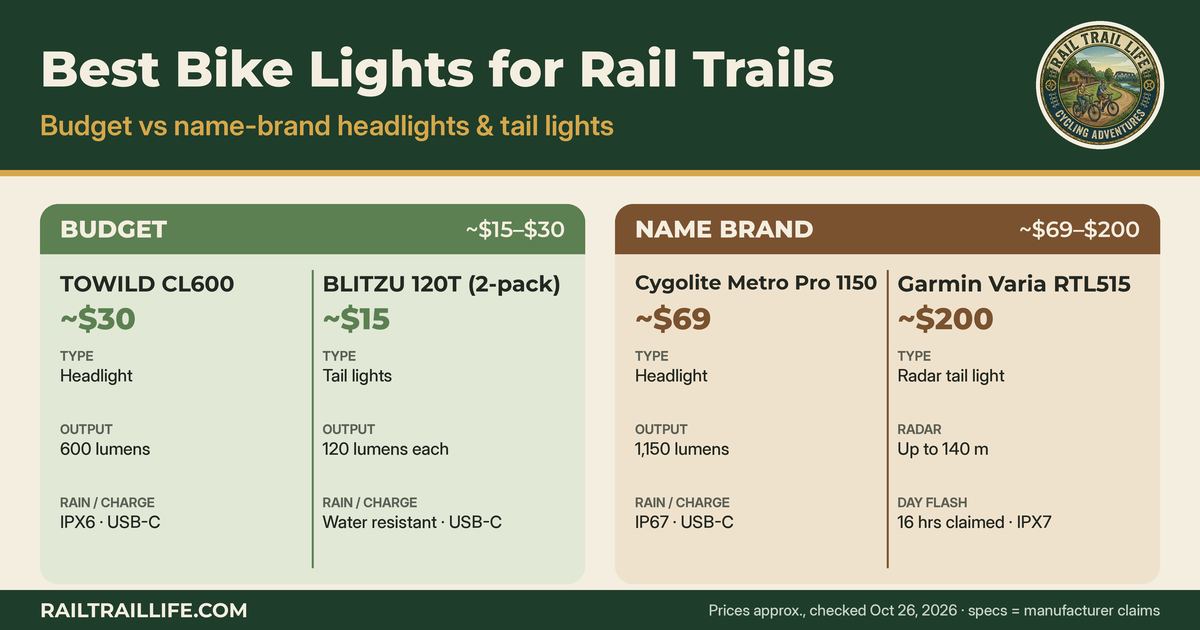
| Victoper VT-BL2001 (set) | TOWILD CL600 | Cygolite Metro Pro 1150 | Magicshine HORI 1300S | NiteRider Lumina 1200 Boost | |
|---|---|---|---|---|---|
| Approx. price (Oct 2026) | ~$13.49 (third-party sellers) | $29.99 ($21.29 Prime price) | ~$69 | ~$66 on Amazon; $89.99 at Magicshine | ~$90 on Amazon (third-party); $84.99 at NiteRider |
| Max output | 150 lumens (front) | 600 lumens | 1,150 lumens | 1,300 lumens (high beam) | 1,200 lumens (Boost) |
| Useful trail mode | Not published | Not published per mode | Medium: 3 hrs | Low beam 400 lm: 3.5 hrs | 400 lm Medium: 3 hrs |
| Longest claimed runtime | Not published | Up to 6 hrs | 100 hrs (walking mode) | 6.5 hrs (200 lm low beam) | 18 hrs (75 lm walk mode) |
| Day flash mode | Flash modes | Not listed | Yes (DayLightning, 14 hrs) | Not confirmed | Yes (pulse and fast flash) |
| Glare control | No | No | No (standard round beam) | Yes, cut-off low beam | No |
| Water rating | IPX4 | IPX6 | IP67 | IPX6 | IP66 per NiteRider (Amazon lists IP64) |
| Charging | USB-C | USB-C | USB-C | USB-C | Micro-USB |
| Weight | Not published | ~140 g | 140 g | 151 g | 172 g |
| Mount | Handlebar strap, rotates 360° | Garmin/GoPro style, above or below bar | Hard clamp, bars up to 35 mm | Dual mount, above or below bar (Garmin/Wahoo compatible) | Handlebar mount, bars up to 35 mm |
| Amazon rating | 4.4★ (thousands of ratings) | 4.5★ (1,449) | New listing, few ratings | 4.6★ (~370) | 4.2★ (~1,300) |
| Amazon ASIN | B0B4JCX6YN | B09YTQHPWB | B0FGZD6CL6 | B0HGDH5TK3 | B07DGF59M2 |
Specs come from manufacturer pages and Amazon listings. “Useful trail mode” is the runtime the brand lists for a medium setting, which is the one I’d expect to use most on a dark, flat trail.
Tail Lights: Side-by-Side Specs
| BLITZU Cyborg 120T (2-pack) | NiteRider Vmax+ 150 | Cygolite Hypershot 350 | COOSPO TR70 (radar) | Garmin Varia RTL515 (radar) | |
|---|---|---|---|---|---|
| Approx. price (Oct 2026) | $14.99 for two | ~$26.47 on Amazon (third-party); $29.99 at NiteRider | $36.59 | ~$66 | $199.99 (has sold for ~$150 on sale) |
| Max output | 120 lumens | 150 lumens | 350 lumens (flashing) | 70 lm day flash; 20 lm most modes | 65 lm day flash; 20 lm solid |
| Claimed runtime | Up to 10 hrs | 4.5 hrs (high steady) to 25.5 hrs (low steady); 11.5 hrs fast flash | 2–200 hrs depending on mode | 14 hrs (high solid) to 30 hrs (flash); 40 hrs radar only | 6 hrs solid, 16 hrs day flash |
| Rear radar | No | No | No | Yes, up to 140 m | Yes, up to 140 m (153 yd) |
| Water rating | Water resistant (see note) | IP66 per NiteRider (Amazon lists IP64) | IP64 | IP67 | IPX7 |
| Charging | USB-C | USB-C | Micro-USB | USB-C | Micro-USB |
| Weight | ~1 oz each | 59 g | 60 g (Cygolite) / 75 g (Amazon) | 64 g (light only) | 71 g |
| Mount | Flexible strap (seatpost, bag, helmet) | Seatpost strap + wearable clip | Hard seatpost and seat stay mounts | Garmin quarter-turn seatpost mount | Garmin quarter-turn seatpost mount |
| Amazon rating | 4.6★ (5,297) | 4.5★ (~330) | 4.6★ (1,706) | 4.6★ (~175) | 4.8★ (3,620) |
| Amazon ASIN | B00W7Y27CQ | B09K22K9MR | B07W62CCL2 | B0FYF4NP62 | B086TVFX1D |
Lumen figures for the radar lights come from Garmin’s spec sheet and road.cc’s COOSPO review. Radar lights trade raw brightness for the radar, so compare them on features, not lumens.
Victoper VT-BL2001 Light Set: The Bare-Minimum Budget Pick (~$13)
If you only ride in daylight and want something on the bike “just in case” the ride runs late, this is about as cheap as a rechargeable front-and-rear set gets. It’s one of Amazon’s best-selling bike lights, with a 4.4-star average across thousands of ratings. You get a 150-lumen front light with six modes, a rear light with four modes, USB-C charging and an aluminum body.
What to watch: 150 lumens is a “be seen” light, not a “see the trail” light. It’s fine at dusk or under streetlights, but on a dark, tree-covered trail it won’t show you much. It’s rated IPX4, which covers splashes and light rain, not a Florida downpour. Victoper doesn’t publish runtimes, so charge it before every ride. Most Amazon listings are from third-party sellers, so check who you’re buying from.
Pros
- Very cheap for a front and rear set
- USB-C charging
- Thousands of buyer ratings
Cons
- Only 150 lumens up front
- IPX4 is light-rain protection only
- No published runtimes
Best for: casual daytime riders who want backup lights and a cheap way to meet the after-dark lighting rules.
TOWILD CL600: The Budget Headlight That Actually Lights a Trail (~$21–$30)
The CL600 is the step up I’d make if you ever ride after sunset. It puts out 600 lumens from an aluminum body with a 2,600 mAh battery, USB-C charging and an IPX6 rating, which is a big jump in rain protection over the cheapest sets. It has a 4.5-star average from about 1,450 ratings and Amazon’s Choice badge.
Two features make it a good rail trail light. First, it mounts on Garmin and GoPro style mounts and can hang below an out-front computer mount, so it shares space with your bike computer. Second, it turns itself off two minutes after it stops sensing vibration and back on when you start rolling, which helps at trailhead stops. TOWILD claims up to about 6 hours of runtime. Buyers say it’s bright enough for trail riding, though a few reported batteries that stopped holding a charge.
Pros
- 600 lumens is plenty for a dark, flat trail
- Under-mount design works with bike computer mounts
- USB-C, IPX6, auto on/off
Cons
- Only three brightness levels
- Runtime is only given as “up to 6 hours”
- Some buyers reported battery failures
Best for: riders on a budget who sometimes finish after dark and already use a Garmin-style out-front mount.
Cygolite Metro Pro 1150: The Best All-Around Headlight (~$69)
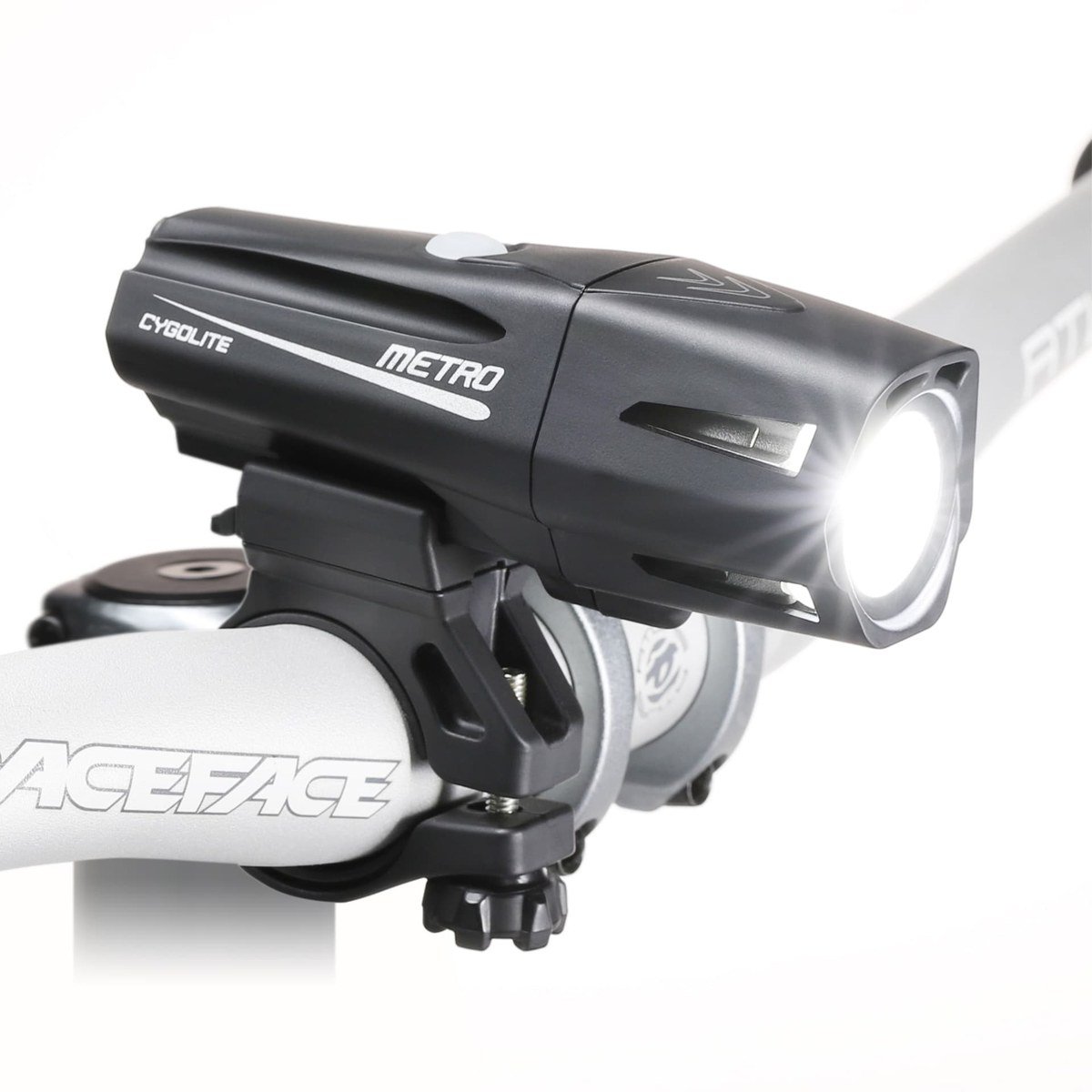
Cygolite’s Metro series has been a commuter favorite for years, and the new Metro Pro 1150 fixes the old version’s biggest gripe by switching to USB-C. It’s a compact 140-gram light rated IP67, which is the best water rating among the headlights here, with a hard clamp that fits bars up to 35 mm.
What I like for rail trails is the mode list. Cygolite publishes runtimes for every mode: Boost 1 hour, High 1.5 hours, Medium 3 hours, Low 10 hours, plus DayLightning flash for daytime (14 hours) and SteadyPulse, a steady beam with a pulse on top, which suits a road crossing at dusk. Cygolite also says the lights are designed and assembled in the USA.
What to watch: it’s a standard round beam with no glare cut-off, so aim it down on shared paths. This USB-C version is a fairly new Amazon listing, so it doesn’t have many buyer reviews yet. The 1,150-lumen Boost mode only lasts an hour, so plan your night rides around Medium or Low.
Pros
- IP67, the best water rating in this group
- USB-C and a secure hard mount
- Useful day and night modes with published runtimes
Cons
- No glare cut-off
- Boost mode only lasts about 1 hour
- New listing with few reviews so far
Best for: most rail trail riders who want one dependable light for dusk, dark trails and daytime visibility.
Magicshine HORI 1300S: The Considerate Headlight for Shared Trails (~$66)
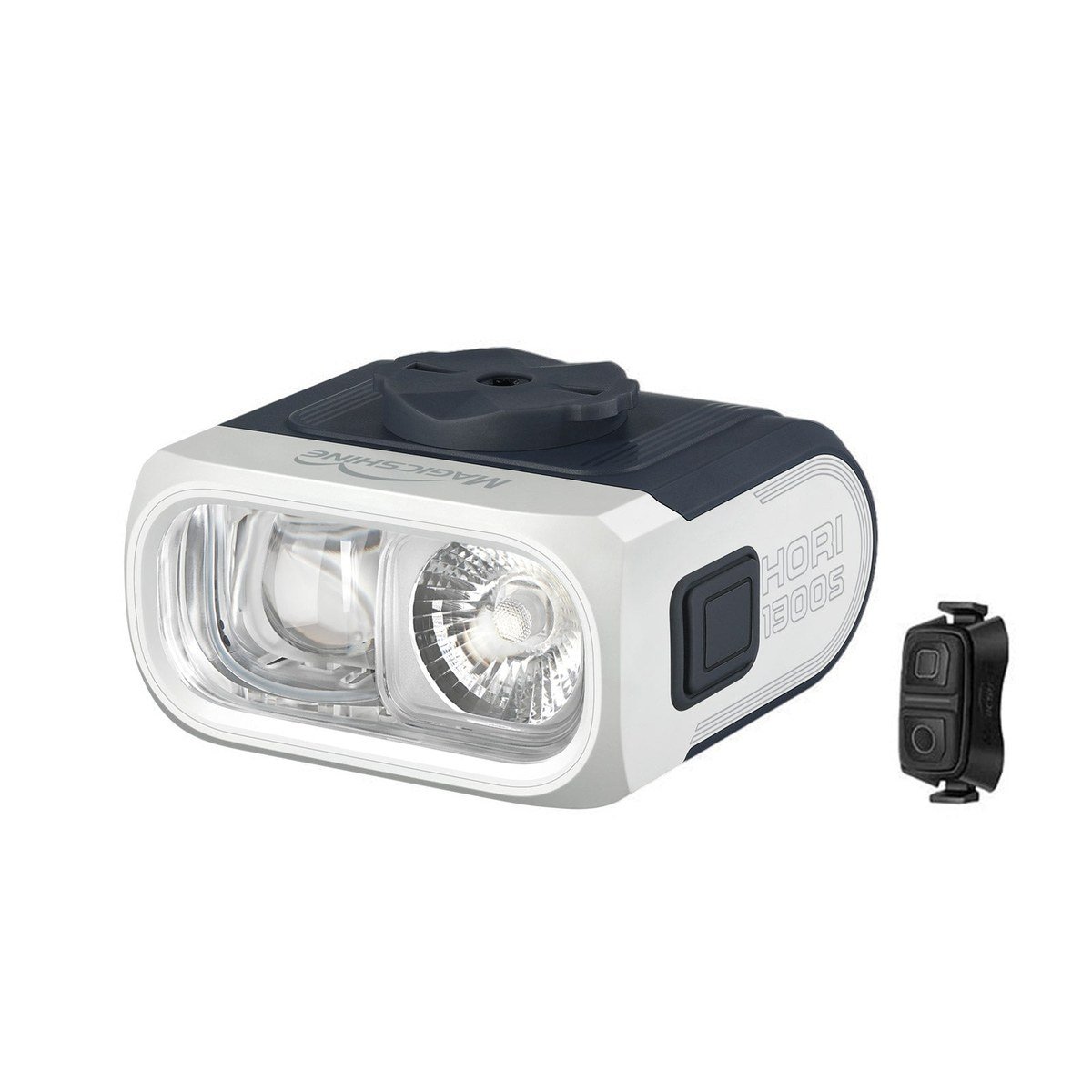
This is the light I’d look at first if you ride crowded trails after dark. The HORI 1300S has two separate beams: a cut-off low beam, which works like a car’s headlights, throwing light on the path while keeping it out of oncoming eyes, and a 1,300-lumen high beam for empty stretches. Magicshine lists low-beam modes of 200 lumens (6.5 hours), 400 lumens (3.5 hours) and 900 lumens (2.5 hours), and the full high beam for about 2 hours.
It charges by USB-C, is rated IPX6, weighs 151 g, and uses a dual mount that can sit above or below the bar and works with Garmin- and Wahoo-style computer mounts. It also supports Magicshine’s app and FTR LightSync system, which pairs it with a compatible Magicshine tail light and remote. On Amazon it was about $66 when I checked, well below Magicshine’s own $89.99.
What to watch: it’s more complicated than a one-button light, and the app features are extras most trail riders won’t need. Magicshine has several HORI versions on Amazon (1300, 1300S, different colors), so make sure you’re looking at the 1300S.
Pros
- Cut-off low beam is polite on shared paths
- USB-C, IPX6, computer-mount friendly
- Good price on Amazon versus list
Cons
- More buttons and settings than most people need
- Several similar versions on Amazon can be confusing
- High beam lasts only about 2 hours
Best for: riders who share trails with walkers and other cyclists after dark and want plenty of light without blinding anyone.
NiteRider Lumina 1200 Boost: The Bright Classic (~$85–$90)
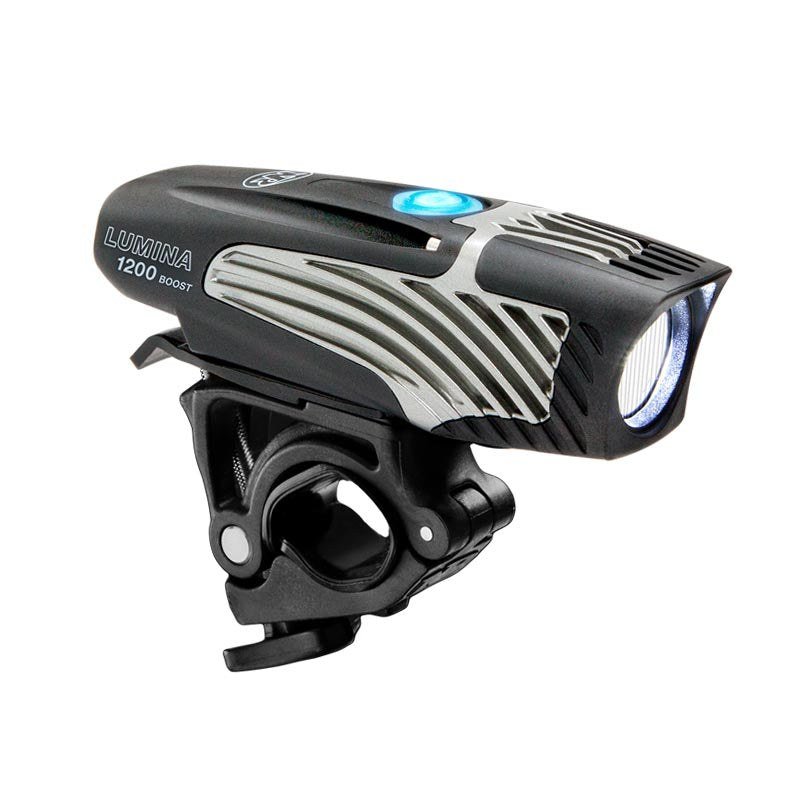
NiteRider’s Lumina has been around a long time, and the 1200 Boost is the brightest light in this group: a double-tap Boost mode at 1,200 lumens (about 55 minutes), High at 800 lumens (1.5 hours), Medium at 400 lumens (3 hours) and Low at 150 lumens (7 hours). It also has two flash modes at 800 lumens for daytime and a 75-lumen walk mode that lasts 18 hours.
What to watch: it still charges by micro-USB, and at 172 g it’s the heaviest headlight here. NiteRider’s own site lists it as IP66, while the Amazon listing says IP64, so treat it as rain-resistant rather than waterproof. On Amazon it was mostly sold by third-party sellers at about $90 when I checked, slightly more than NiteRider’s direct price of $84.99. Amazon buyers rate it 4.2 stars, a bit lower than the Cygolite.
Pros
- Most raw brightness in this group
- Published runtimes for every mode
- Long-proven design with a big mount range
Cons
- Micro-USB charging
- Heaviest headlight here
- More light than a flat trail usually needs
Best for: riders who also do faster road or gravel rides at night and want maximum light, or anyone who already owns NiteRider gear.
BLITZU Cyborg 120T: The Best Budget Tail Light (~$15 for Two)
For $14.99 you get two USB-C tail lights with 120 lumens each, four modes, and a flexible strap that fits seatposts, seat stays, saddle bags, helmets and backpacks. It’s one of Amazon’s top-selling bike tail lights, with a 4.6-star average from more than 5,000 ratings. Two lights means one for your bike and one for a riding partner, or one on the bike and one on your helmet for extra height.
What to watch: BLITZU claims up to 10 hours per charge, but some buyers report much shorter runtimes, so I’d treat 10 hours as a best case. The listing calls it waterproof without giving an IP rating on Amazon. The most common complaint is the rubber strap breaking after a few months, so it’s worth carrying a spare.
Pros
- Two USB-C lights for about $15
- Flexible mounting almost anywhere
- Huge number of positive ratings
Cons
- Runtime claims look optimistic
- Straps can break
- No IP rating on the Amazon listing
Best for: anyone on a tight budget, families equipping several bikes, or as a second “backup” tail light.
NiteRider Vmax+ 150: A Small, Simple Name-Brand Tail Light (~$26–$30)
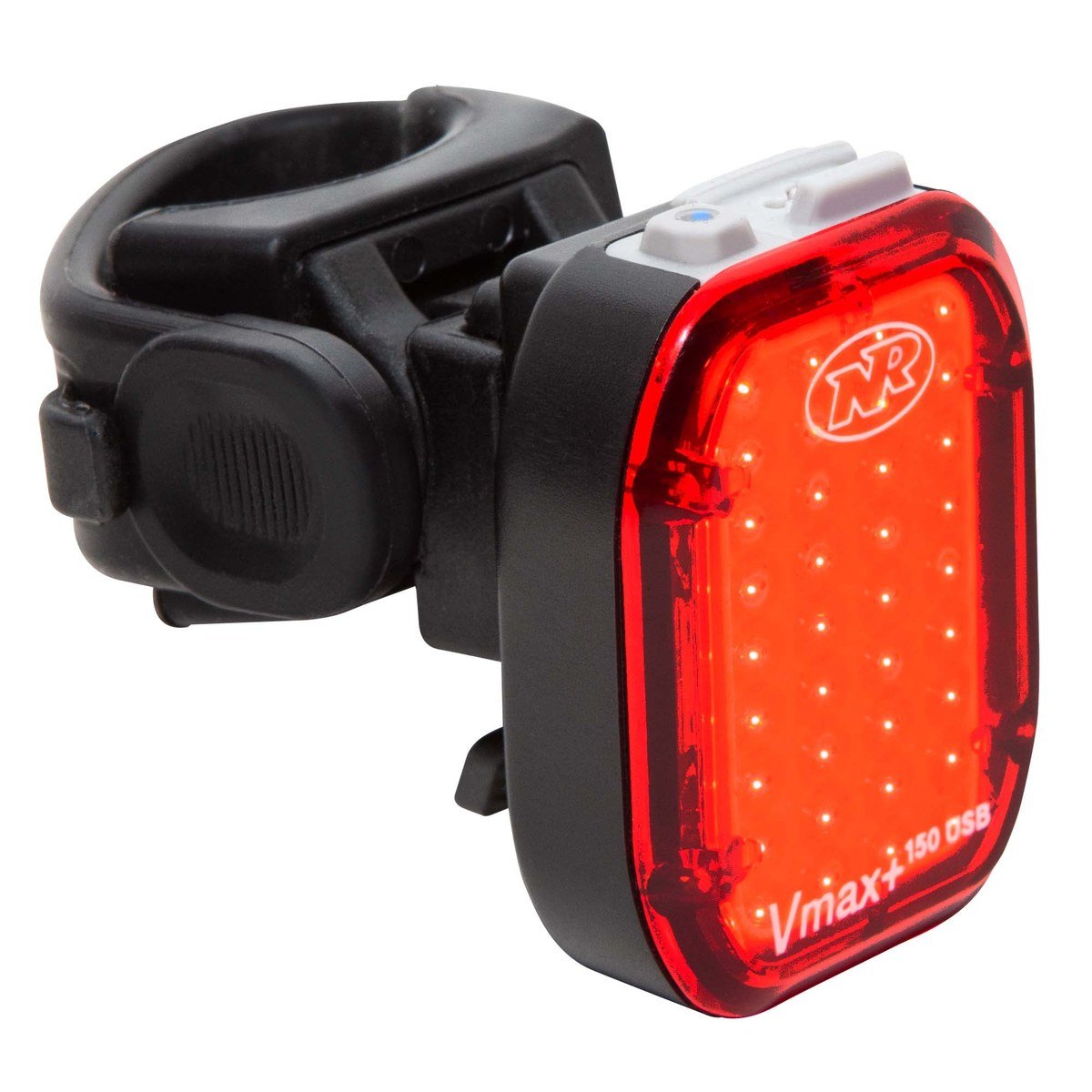
The Vmax+ 150 is a compact 150-lumen COB tail light (COB means a dense panel of small LEDs, which gives a wide, even glow) with USB-C charging and mode memory. It weighs 59 g and has six modes. NiteRider lists 11.5 hours on fast flash and 25.5 hours on low steady, and it charges in about 2 hours. A built-in clip lets you wear it on a bag strap or jersey instead of the seatpost.
What to watch: on high steady it only runs about 4.5 hours, so use a flash mode for long daytime rides. NiteRider’s site lists it as IP66, while Amazon says IP64. When I checked, Amazon’s price came from third-party sellers, so compare with NiteRider’s $29.99 direct price.
Pros
- USB-C and light (59 g)
- Wide COB light panel
- Wearable clip as a bonus
Cons
- Short runtime on high steady
- Listing sold by third-party sellers
- Not as bright as the Cygolite
Best for: riders who want a simple, reputable USB-C tail light without paying radar prices.
Cygolite Hypershot 350: The Daytime Attention-Getter (~$37)
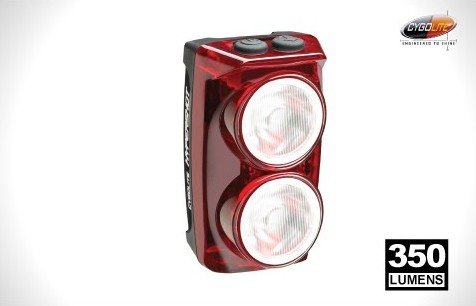
If drivers at road crossings are your biggest worry, this is a tail light built to be seen in daylight. The Hypershot 350 flashes at up to 350 lumens, about three times brighter than the BLITZU, with seven modes including DayLightning and SteadyPulse. Two buttons let you adjust each mode’s flash speed and the steady mode’s brightness, and Cygolite claims 2 to 200 hours of runtime depending on the mode. It’s an Amazon’s Choice item with a 4.6-star average from about 1,700 ratings, and it was $36.59, shipped and sold by Amazon, when I checked.
What to watch: it charges by micro-USB, which is the most common complaint in Amazon reviews, and it’s rated IP64 (splash-resistant), so don’t leave it out in a storm. Cygolite now lists the 350 as an archived model, with newer Hypershot versions on its site, but the 350 is still widely sold on Amazon.
Pros
- Very bright daytime flash
- Adjustable flash speed and brightness
- Sold by Amazon, strong ratings
Cons
- Micro-USB charging
- IP64 is splash-resistant only
- Older model, replaced by newer versions on Cygolite’s site
Best for: daytime riders whose trails cross busy roads and who want the brightest flash for the money.
COOSPO TR70: The Best-Value Radar Tail Light (~$66)
A radar tail light detects vehicles approaching from behind and alerts you on your bike computer or phone, often before you can hear them. On a rail trail, that matters most where the trail runs alongside a road or where you ride on-road connectors between trail sections. Until recently that meant paying Garmin prices. The COOSPO TR70 costs about a third as much.
On paper it’s strong: radar detection from 5 to 140 meters, ANT+ and Bluetooth (so it works with Garmin, Wahoo, Bryton and iGPSPORT computers or COOSPO’s free phone app), USB-C charging and an IP67 rating. road.cc gave it 9/10 and found its radar alerts went off at the same time as a Garmin Varia in a side-by-side test. They measured about 13.5 hours on its high solid mode (claimed 14) and beat the claimed 22 hours in its breathing mode. Its light is modest: most modes are 20 lumens, with a 70-lumen day flash.
What to watch: it has far fewer Amazon ratings than the Garmin. Readers of the road.cc review also noted that early units shipped with older firmware that worked less well, so update the firmware in the app when it arrives. It’s a radar first and a light second, so on busy crossings in bright sun you may want a brighter flasher too.
Pros
- Radar for about a third of Garmin’s price
- USB-C, IP67, long battery life
- Works with most bike computers or a phone app
Cons
- Light output is modest
- Fewer reviews; update the firmware
- Lesser-known brand
Best for: riders who want radar on a budget, especially on trails with road sections or busy crossings.
Garmin Varia RTL515: The Premium Radar Tail Light (~$200, Often Less)
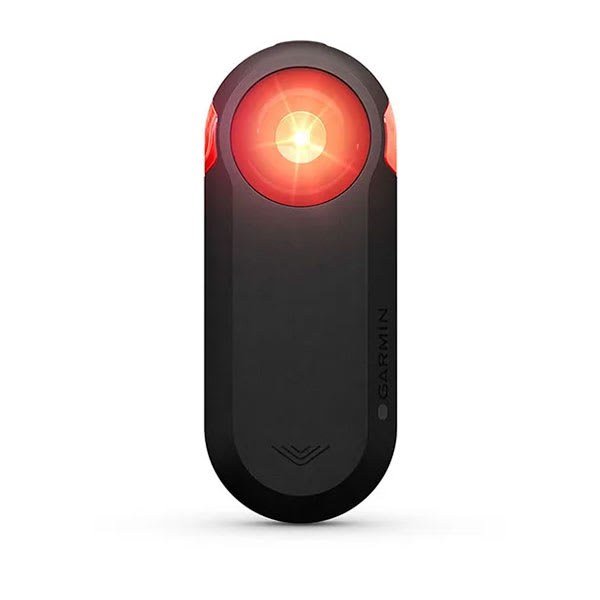
The Varia RTL515 is the radar light most other radars get compared to. It detects vehicles up to 140 meters (153 yards) behind you and shows them on a Garmin Edge computer, Garmin’s Varia phone app or the Ride with GPS app. It’s the best-rated light in this article on Amazon, at 4.8 stars from about 3,600 ratings, and some buyers note it also picks up faster riders coming up behind them on trails. Garmin rates it IPX7 and lists 6 hours in solid mode, 8 in peloton mode, and 16 hours in day flash, with up to 65 lumens in day flash.
What to watch: it’s showing its age. It still charges by micro-USB (both DC Rainmaker and road.cc point this out), and its battery life trails newer radars like the COOSPO. Amazon reviewers are split on battery life, and some report less than the claimed runtime. It was $199.99 on Amazon when I checked, but price trackers show it often drops to around $150, so it may be worth waiting for a sale.
Pros
- Proven radar with huge compatibility
- Highest Amazon rating here
- IPX7 and a solid quarter-turn mount
Cons
- Micro-USB in 2026
- Shorter battery than newer radars
- Expensive at full price
Best for: riders already using a Garmin Edge or watch, or anyone who wants the most proven radar and is willing to pay for it.
Which Should You Buy?
Under $35 total: “I mostly ride in daylight but want to be covered.”
Get the Victoper set if you rarely ride at dusk. If you sometimes finish after dark, pair the TOWILD CL600 with the BLITZU 120T 2-pack instead. That gets you a headlight that actually lights a trail plus two tail lights for well under $50.
About $100: “I ride evenings and want gear I don’t have to think about.”
Pair the Cygolite Metro Pro 1150 with the Cygolite Hypershot 350. You get strong day flash modes front and rear, a waterproof IP67 headlight and published runtimes. If you prefer USB-C on both ends, swap the Hypershot for the NiteRider Vmax+ 150.
About $130: “I share busy trails after dark and want radar.”
Pair the Magicshine HORI 1300S (cut-off low beam) with the COOSPO TR70 radar. All USB-C, considerate to oncoming riders, and you’ll know when a car is coming on road sections.
Premium: “I’m a Garmin person.”
Pair the Garmin Varia RTL515 with the NiteRider Lumina 1200 Boost or the HORI 1300S. Watch for a Varia sale before you buy.
By rider type:
- Casual weekend daytime rider: Victoper set or BLITZU 120T
- Evening or after-work rider: Cygolite Metro Pro 1150 + Hypershot 350
- Busy shared trail after dark: Magicshine HORI 1300S
- Trails with road sections or busy crossings: COOSPO TR70 or Garmin Varia RTL515
A Note From Michael
I’m Michael, and I’ve been riding rail trails for a couple of years, mostly around Northeast Florida, like the Jacksonville-Baldwin Rail Trail. I haven’t tested these particular lights, so everything above comes from the manufacturers’ specs and published reviews. What I’ve learned from riding is that the light matters most at road crossings in daylight and in the last half hour of a ride that ran long. A bright tail light that’s on from the moment I leave the parking lot, and a headlight I can aim down when someone’s coming the other way, are the two things I’d spend money on first.
FAQ
How many lumens do I need for a rail trail?
For being seen at dusk, 100–200 lumens is enough. For riding a dark, unlit trail at relaxed speeds, 300–600 lumens is plenty, and that’s the range I’d actually run. Higher numbers are useful headroom, but on a shared trail they mostly just blind people.
Should I run my lights during the day?
Yes, especially a flashing tail light. Daytime running lights help drivers notice you at road crossings, and the brands here all include day flash modes for exactly that.
Is it okay to use a flashing headlight on a trail?
A front flash is great in daylight and at road crossings. On a dark trail with oncoming riders and walkers, a steady beam aimed down is more courteous. Modes like Cygolite’s SteadyPulse are a good compromise.
Do I really need a radar tail light on a rail trail?
Not on a trail that’s fully separated from traffic. Radar earns its keep where the trail runs along a road, where you ride road connectors between trails, or where you ride to the trailhead. If that’s you, the COOSPO TR70 makes it affordable.
What IP rating do I need for Florida rain?
For regular riding through summer storms I’d look for IPX5 or higher. Every light here except the Victoper set (IPX4) and the BLITZU (no IP rating on its Amazon listing) claims IP64 or better, and the Cygolite Metro Pro 1150 (IP67), COOSPO TR70 (IP67) and Garmin Varia (IPX7) are the most weatherproof.
Are cheap Amazon bike lights any good?
Many are fine for being seen, and some, like the TOWILD and BLITZU, have thousands of solid ratings. Be skeptical of huge lumen claims on no-name lights (some listings advertise thousands of lumens from tiny batteries), and look for published runtimes and an IP rating.
What does Florida law require after dark?
Between sunset and sunrise, a white front light visible from at least 500 feet, plus a red rear light and a red rear reflector visible from 600 feet (Florida Statutes §316.2065). Extra lights are allowed.
Bottom Line
For rail trail riding, you don’t need the brightest light on the shelf. You need a headlight with a sensible 300–600 lumen mode you can aim down, a tail light bright enough to catch a driver’s eye in daylight, and batteries that outlast your ride. On a budget, the TOWILD CL600 and BLITZU 120T cover that for well under $50. The Cygolite Metro Pro 1150 and Hypershot 350 are my all-around picks, and the Magicshine HORI 1300S is the kindest light for crowded trails. If you ride near traffic, a radar tail light, either the value COOSPO TR70 or the proven Garmin Varia RTL515, is the one upgrade worth paying extra for.
What lights are on your bike right now? Tell me in the comments or tag @railtraillife on Instagram.
As an Amazon Associate I earn from qualifying purchases. Prices and availability are accurate as of the date checked and are subject to change. Specs and runtimes are manufacturer claims unless a review is named.
Sources: Cygolite Metro Pro 1150 and Hypershot 350 spec pages (cygolite.com); Magicshine HORI 1300S product page (magicshine.com); NiteRider Lumina 1200 Boost and Vmax+ 150 product pages (niterider.com); Garmin Varia RTL515 specifications (garmin.com); COOSPO TR70 product page (coospo.com); Victoper VT-BL2001 product page (victoper.com); road.cc COOSPO TR70 review (March 2026); DC Rainmaker Garmin Varia RTL515 review; Florida Statutes §316.2065 (flsenate.gov); Amazon.com listings, ratings and buyer reviews (checked Oct 26, 2026); camelcamelcamel price history.